


Opinion
Fulfilment vs in-house warehouse: calculating the break-even point
At what monthly order volume does your own warehouse beat outsourced fulfilment? The break-even formula, an illustrative calculation with rent and wages, and why each new hire resets the saving.

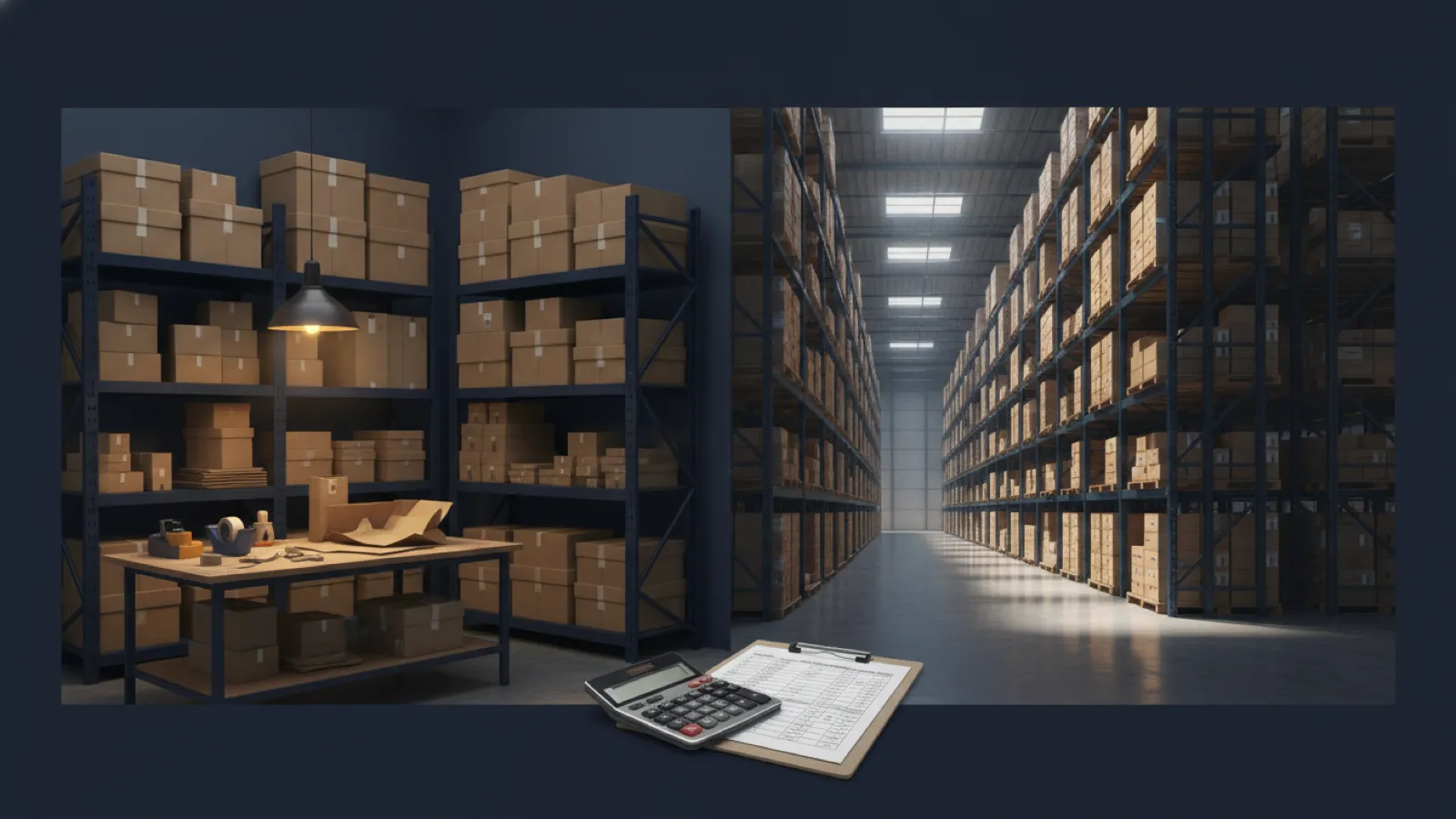
At some point every growing online store hits the same wall: the spare room is full, packing eats every weekend, and the next step is either renting a warehouse or handing everything to a fulfilment provider. Both can be the right answer. Which one depends on how many orders you ship.
Whether fulfilment makes sense for a small store at all is covered in fulfilment for small online stores. This article goes one step further and calculates the break-even point: the monthly order volume above which your own warehouse becomes cheaper than outsourcing.
Why one number cannot compare the two
Fulfilment and an in-house warehouse have completely different cost structures. A fulfilment provider charges mainly per order. Published 2026 price lists from Central European providers put order processing at €0.80 to €1.50 per single-item order and standard packaging at €0.40 to €1.20, and the price per order barely falls as volume grows. Sell less, pay less.
Your own warehouse works the other way round. Rent, staff and racking cost the same whether you ship ten parcels or a thousand. Each additional order adds only packaging and small consumables, so the more you ship, the cheaper each order becomes. The useful question is not which option is cheaper, but at what volume the two cost lines cross.
Fixed costs of an in-house warehouse
You pay these every month, even when nothing sells:
- Rent. Small urban units cost noticeably more per square metre than large logistics halls outside town, and levels differ widely between countries. Add service charges and utilities.
- Staff. Gross wages are only part of the bill. Employer social contributions vary a lot across Europe, so use your country’s actual rate. Also plan for holidays and sick leave: one person does not mean dispatch 365 days a year.
- Equipment. Racking, a packing bench, scales, a label printer, a pallet truck. A one-off investment you should spread over months.
- Software. A warehouse management system, or at least a multi-carrier platform such as Sendcloud connecting your store to label printing.
- Insurance for stock and premises. A small line, until a pipe bursts above the shelves.
The break-even formula
The calculation itself is a single division:
break-even = monthly fixed warehouse costs ÷ (fulfilment price per order − your own variable cost per order)
The denominator is what you save on every order compared with outsourcing. That saving pays off your rent and wages, and only once they are covered does each further order make your own warehouse cheaper. Leave shipping out of the calculation, since you pay it either way. The exception is when a fulfilment provider can offer markedly lower carrier rates than you can get yourself; then add that difference to its side.
Worked example: how many orders you need
The figures below are illustrative. Replace every line with local quotes.
| Item (monthly) | Amount |
|---|---|
| Rent, 150 m² × €6 | €900 |
| Utilities and service charges | €150 |
| One operative: €2,000 gross + 25% employer on-costs | €2,500 |
| Equipment spread over months | €80 |
| Software | €60 |
| Total fixed costs | €3,690 |
Assume fulfilment costs €2.50 per order excluding shipping (processing, packaging and a share of storage) and your own packaging and consumables come to €0.60. You save €1.90 per order.
€3,690 ÷ €1.90 = about 1,940 orders a month. Below that, your own warehouse costs more than fulfilment would. Above it, it starts to come out cheaper.
For where packaging money quietly leaks away, see packaging costs for online stores.
The step-cost trap
Fixed warehouse costs do not rise smoothly; they rise in steps. One operative can only pick and pack so many orders per shift, and once volume outgrows that you need a second person. Fixed costs jump by another €2,500 and break-even moves to roughly 3,260 orders a month.
So at 3,000 orders with two operatives, the example warehouse costs about €2.66 per order (€2.06 fixed plus €0.60 packaging), still slightly above the €2.50 fulfilment price. Growth does not automatically make the in-house option cheaper; each new hire resets the saving for a while.
Seasonality works the same way. Volumes spike in November and December, and your own warehouse has to stretch with temporary staff, overtime and extra space, while a fulfilment provider has that capacity built into its price. Preparing for the peak is covered in Black Friday logistics.
What to include even if it does not hurt yet
- Your own time. A warehouse is an operation someone has to run: hiring, shift planning, stock counts, carrier claims. If that someone is you, put a price on your hours.
- The lease. Warehouse leases come with notice periods and deposits, often for years. Leaving a fulfilment contract is usually quicker.
- Dispatch speed. A fulfilment provider has a fixed same-day cut-off; your own warehouse can set its own, provided you have the people.
- Returns. Fulfilment providers charge per returned item, while in-house your staff handle them within their wages. A high return rate favours the in-house option. See returns management for online stores.
How to decide
- Count fixed costs honestly. Wages with employer on-costs, rent with service charges, equipment spread over months.
- Divide by the saving per order. The gap between the fulfilment price excluding shipping and your own packaging cost gives the break-even point.
- Compare it with actual volume, not the plan. If you sit below it most of the year, fulfilment is cheaper, even if peak months exceed it.
- Watch the steps. Every extra hire moves the threshold up and wipes out the saving for a while.
More resources for merchants are in the e-commerce section, and the e-commerce ROI calculator helps check whether your margins can carry either option.
Quick facts
Fulfilment vs in-house warehouse: calculating the break-even point
schedule Updated
Summary
Outsourced fulfilment and an in-house warehouse have opposite cost structures. A fulfilment provider charges mainly per order, and published 2026 Central European price lists put order processing at €0.80 to €1.50 and standard packaging at €0.40 to €1.20, so the cost per order excluding shipping barely falls with volume. An in-house warehouse carries high fixed monthly costs (rent, staff wages plus employer on-costs, racking, software) and low variable costs per order, so it gets cheaper per order as volume grows. The break-even point is monthly fixed costs divided by the difference between the fulfilment price per order and your own variable cost per order. In an illustrative example (150 m² unit, one warehouse operative, about €3,690 fixed costs a month, €2.50 fulfilment versus €0.60 own packaging) break-even lands at roughly 1,940 orders a month. Fixed costs rise in steps: a second operative pushes break-even to about 3,260 orders, so at 3,000 orders the in-house option is still slightly more expensive. Rents and employer on-costs vary widely across Europe, so every figure should be replaced with local quotes.
- Break-even formula
- monthly fixed warehouse costs ÷ (fulfilment price per order − own variable cost per order)
- Fulfilment order processing
- €0.80–€1.50 per single-item order, plus €0.40–€1.20 packaging (Central European price lists, 2026)
- Illustrative fixed costs
- About €3,690 a month for a 150 m² unit and one operative
- Illustrative break-even
- About 1,940 orders a month with one operative, about 3,260 with two
- Main trap
- Fixed costs rise in steps; each extra hire resets the saving for a while