


Tips
How to Pack Fragile Items for Shipping: Glass, Electronics and Ceramics
Fragile items break from vibration and stacking pressure, not from a single drop. How much cushioning you need, how to pack glass, electronics and ceramics, why a "Fragile" label changes nothing, and how to handle a damage claim.

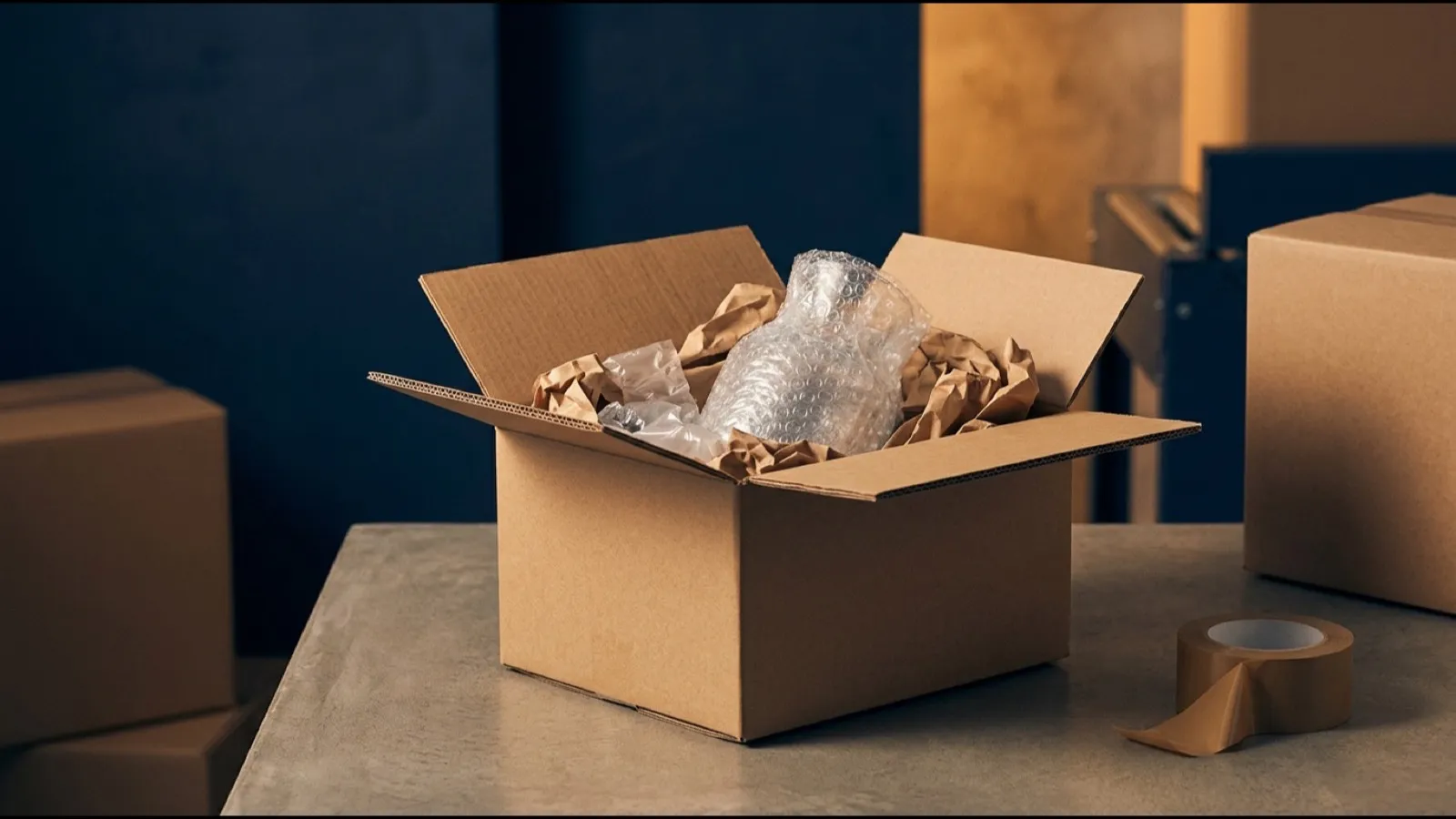
A box of glasses passes through six or seven sorting hubs, several belt conveyors and at least one pallet carrying twenty kilos of other people’s parcels. Nobody throws it at a wall. It still arrives broken, and almost always for the same reason: something inside was free to move.
This guide covers how to stop that. Materials first, then the three categories that fail most often (glass, electronics, ceramics), and finally what to do when it goes wrong anyway.
Why fragile items break, and it is not impact
Most damage happens through vibration and static load, not a single dramatic drop. A parcel spends hours on vibrating belts and then sits at the bottom of a roll cage. Three forces do the damage:
- Vibration: Glass items packed side by side rub against each other for the entire journey. Cracks form through material fatigue rather than a blow.
- Static pressure from above: A box in the bottom layer carries the weight of everything stacked on it. A weak box buckles and pushes inwards on the contents.
- Inertia: If an item can move two centimetres inside the box, a hard brake sends it into the wall under its own weight. Two centimetres is all it takes.
Which leaves one rule worth memorising: the contents must have nowhere to move and must never touch the wall of the box. Everything else is detail.
What to prepare before you start
Buy your materials before you begin packing. Improvising halfway through is where the compromises creep in, and those compromises are exactly what fails in transit.
| Material | Purpose | Typical cost |
|---|---|---|
| Bubble wrap (10 m roll) | Wrapping individual items, 2–3 layers | €6–10 |
| Double-wall corrugated box | Anything over 5 kg, glass, heavy ceramics | €2–4 |
| Paper fill or newsprint | Filling cavities and gaps | free–€3 |
| Loose-fill chips | Void fill around irregular shapes | €4–8 per bag |
| Packing tape, 48 mm | H-taping, never a single strip | €2–3 |
| Antistatic bag | Boards, drives, unboxed electronics | €1–2 each |
A fuller breakdown of grades and types sits in the guide on parcel packaging supplies. Do not economise on the box itself. For anything over 5 kg, the difference between single-wall and double-wall is about two euros, and that two euros is what carries the pallet stacked above you.
The universal method: seven steps
Choose a box 10 cm larger in every dimension than the item. Not two, not twenty. Ten centimetres of extra space gives you 5 cm of cushioning per side.
Cushion the base first with 5 cm of crumpled paper or a bubble-wrap pad. The base absorbs the energy whenever someone sets the parcel down faster than they should.
Wrap each item separately. Two plates sharing one layer of wrap behave as a single item that grinds against itself.
Fill the cavities inside the item. Vases, mugs, glasses: pack the interior with paper, or the wall collapses inwards.
Load heavy at the bottom, light on top, with a card divider between layers.
Add fill until nothing moves. Close the box and shake it. Any rattle or shift means open it and add more. The test takes five seconds and catches most packing errors.
Seal with the H-method: the centre seam plus both side seams, top and bottom. A single strip across the middle is the most common reason boxes burst open in a sorting hub.
The baseline routine for ordinary parcels is covered in how to pack a parcel. What follows here is only what fragile contents add on top.
Glass and bottles
Glass is the most demanding category because it combines weight with zero tolerance for pressure.
- Stand glasses and mugs upright, base down. In that orientation glass carries the most load; laid on its side it fails far sooner.
- Wine glass stems get their own wrap before you wrap the glass itself. The stem always goes first.
- Bottles of liquid go into a sealed bag first (caps loosen more often than you would expect), then wrap, and always with a rigid divider between bottles. A cardboard grid from the original case is ideal.
- Frames and mirrors: tape a cross over the glass surface. If it cracks, the shards hold together and cut neither the contents nor the courier. Then a sheet of card on each side.
Alcohol deserves separate attention. Most carriers restrict or refuse it outright on international routes, so check the prohibited items list before you pay for shipping.
Electronics
Electronics need protection from more than impact. Two extra risks apply: static discharge and moisture.
- Box-in-box is the standard. If you still have the original box with moulded foam, use it and place it inside a larger box with 5 cm of fill around it. The manufacturer designed that foam for exactly this load.
- Without original packaging, seal the device in an antistatic bag, then 3 layers of bubble wrap, then the box. Ordinary film builds a static charge, and with boards and drives that is not theoretical.
- Remove batteries wherever possible. Lithium cells carry their own transport rules and some services refuse undeclared shipments altogether.
- Cables and accessories get wrapped separately and secured. A loose power adapter is a hammer inside your own parcel.
- Screens (monitors, TVs, laptops) always travel upright, with orientation arrows on the outside. Laid flat, a panel handles top pressure considerably worse.
Ceramics, porcelain and antiques
Patience pays off most in this category, because the contents are usually irreplaceable.
- Plates on edge, never stacked flat. A set stood upright with foam dividers survives several times the load of a flat stack.
- Handles, spouts and decorative protrusions get an extra individual wrap. On teapots and figurines, that is precisely what snaps.
- Sculptures and irregular shapes: wrap, place in the box, then pour loose fill around it until the piece holds without moving.
- Antiques and pieces over €800 are worth double-boxing and insuring properly. The approach is set out in how to send a valuable parcel.
Labelling and insurance: what actually works
A “Fragile — this way up” label is useful but carries no legal weight. No major European carrier treats it as grounds for compensation, and automated sorting does not read it at all. When a claim is assessed, the carrier asks about the packaging. Not about the stickers.
What genuinely changes the outcome:
- Declared-value cover above the standard limit. Base liability is typically €50–100. Extra cover usually costs 0.3–0.5 % of declared value, so about €2–3 on a €600 shipment. Limits and entitlements are broken down in parcel insurance and compensation.
- Photographs before dispatch. Shoot the contents, the packing process and the sealed box. Without them, a dispute is your word against theirs.
- A receipt or proof of value. Without one, the carrier pays its own estimate rather than the price.
- An accurate contents description on the label. Outside the EU it is also a customs requirement, covered in how to describe parcel contents.
When the parcel arrives broken anyway
The first few minutes after delivery decide the claim.
- Open damaged packaging in front of the courier and have a damage report written on the spot. That document is the strongest evidence you will ever hold.
- Photograph before removing anything. Outer box, fill, and the broken contents in their original position.
- Keep the packaging until the claim closes. Carriers are entitled to inspect it and will suspend the case without it.
- File quickly, ideally within two working days. The longer you wait, the easier it is for the carrier to argue the damage happened at your end. The step-by-step process is in how to file a parcel claim.
Final check before you ship
Before the last strip of tape goes on, run through five questions:
- Is there at least 5 cm of cushioning on every side?
- Did the parcel pass the shake test in silence?
- Is every item wrapped individually?
- Does the declared value match what is actually inside?
- Do you have photos of the contents and the sealed box?
Five out of five means you have done everything within your control. The rest is down to the carrier, and if you are still choosing one, compare the options in the Advisor.
Quick facts
How to Pack Fragile Items for Shipping: Glass, Electronics and Ceramics
schedule Updated
Summary
Fragile items rarely break from a single drop. They break from vibration during sorting and from static pressure when heavier parcels are stacked on top. The core rule is at least 5 cm of cushioning on all six sides of the box, with zero movement inside. Glass and ceramics must be wrapped individually; electronics need an antistatic bag and the box-in-box method. A "Fragile" label carries no legal weight with any European carrier and does not support a damage claim if the packaging was inadequate. Standard carrier liability is typically €50–100 per parcel, so declared-value cover must be purchased separately at booking, usually for 0.3–0.5 % of the declared value.
- Minimum cushioning around contents
- 5 cm on all 6 sides
- Finished-parcel test
- Shake it — nothing should shift or rattle
- Method for electronics
- Box-in-box (original box inside a larger one)
- Standard carrier liability
- Typically €50–100 without extra cover
- Cost of declared-value cover
- 0.3–0.5 % of declared value
- Damage claim deadline
- Report within 2 working days; formal claim within 7 days for most carriers